

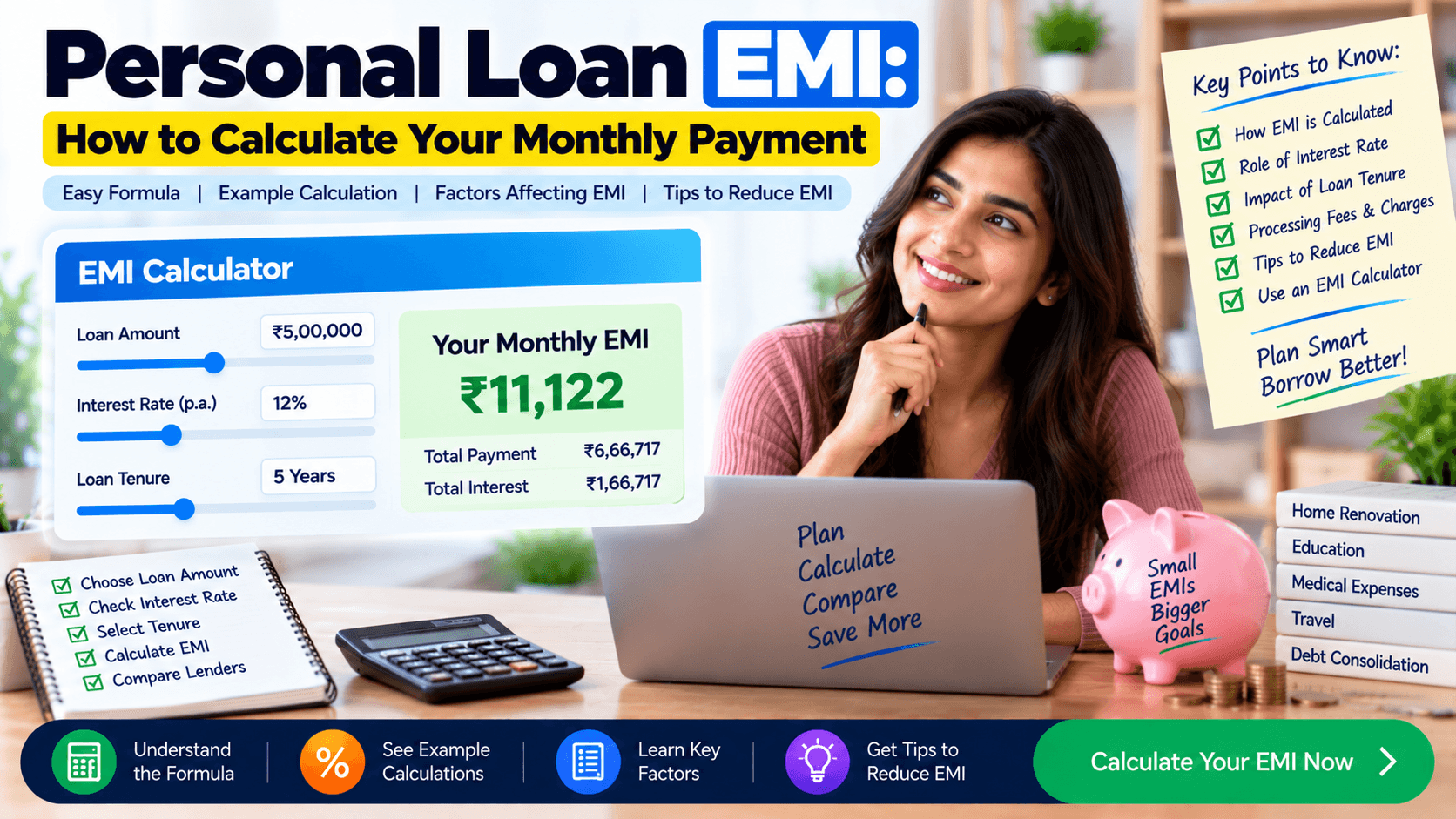
When you take a personal loan from an Indian bank or NBFC, the most common question that follows is, "What will my monthly EMI be?" EMI (Equated Monthly Installment) is the fixed amount you pay every month until the loan is fully repaid. Knowing how to calculate it helps you plan your household budget, compare offers, and avoid unpleasant surprises.
Loan amount (principal): The total money you borrow.
Interest rate: Usually quoted as an annual percentage rate (APR). Indian lenders typically charge between 10%–24% for personal loans, depending on credit score, income, and the lender's policy.
Tenure: The number of months you choose to repay the loan. Common tenures range from 12 to 60 months.
Processing fees & other charges: These are one‑time costs and do not affect EMI, but they increase the overall cost of borrowing.
The standard EMI calculation uses the reducing‑balance method, which reflects the decreasing principal over time. The formula is:
EMI = [P × R × (1+R)^N] / [(1+R)^N – 1]
Where:
P = Loan amount (principal)
R = Monthly interest rate (annual rate ÷ 12 ÷ 100)
N = Total number of monthly installments (tenure in months)
Even if the math looks intimidating, you can quickly compute EMI using an online calculator or a spreadsheet.
Suppose you need a personal loan of ₹5,00,000 for 3 years (36 months) at an annual interest rate of 14%.
Convert the annual rate to a monthly rate:
R = 14 / (12 × 100) = 0.0116667 (or 1.16667%)Plug the values into the formula:
EMI = [5,00,000 × 0.0116667 × (1+0.0116667)^36] / [(1+0.0116667)^36 – 1]
EMI ≈ ₹16,647
Result: You will pay roughly ₹16,647 every month for 36 months, totaling ₹59,93,292 in repayments (including interest).
Compare interest rates: A 1% difference in rate can change your EMI by several hundred rupees. Use comparison portals like BankBazaar, PaisaBazaar, or directly check bank websites.
Opt for a shorter tenure if affordable: Shorter tenures reduce total interest paid, though the EMI will be higher.
Check for pre‑payment and foreclosure charges: Some lenders levy penalties for early repayment. Knowing these helps you decide if a pre‑payment makes sense.
Factor in processing fees: While they don't affect EMI, they add to the total cost. Look for lenders offering fee waivers for high credit scores.
Maintain a healthy credit score (750+): A better score can fetch you a lower interest rate, directly lowering your EMI.
Use an EMI calculator before applying: Most Indian banks (SBI, HDFC, ICICI, Axis) provide an online tool. Enter the loan amount, rate, and tenure to see the exact figure instantly.
Ignoring hidden charges: Some lenders advertise low rates but add high processing or administrative fees.
Choosing the longest tenure to lower EMI: While the monthly payment looks attractive, you may end up paying 30%–40% more in interest over the loan life.
Not checking salary‑linked loan options: Many banks offer lower rates for salaried employees with automatic salary deduction.
Forgetting tax benefits: Personal loan interest is generally not tax‑deductible, unlike home loan interest. Avoid assuming a tax advantage.
Most Indian bank websites follow a similar UI. Here’s a generic workflow:
Navigate to the "Personal Loan EMI Calculator" page.
Enter the loan amount (e.g., ₹5,00,000).
Select the interest rate (you can use the lender’s advertised rate or a market average).
Choose the tenure in months or years.
Click "Calculate" – the tool instantly displays the EMI, total interest, and total repayment.
Some calculators also let you toggle options like "Include processing fee" or "Show amortization schedule" for deeper insight.
✅ Verify the effective annual rate (EAR) – it includes all fees.
✅ Ensure the EMI fits comfortably within your net monthly income (ideally < 30% of take‑home salary).
✅ Ask for a written schedule of pre‑payment penalties if you plan to clear the loan early.
✅ Request a copy of the amortization table – it shows how each EMI splits between interest and principal.
✅ Double‑check the disbursement timeline – some lenders release funds within 24 hours, others take a week.
Calculating your personal loan EMI is not rocket science, but it is a vital step toward responsible borrowing. By understanding the components, using the right formula or an online calculator, and following the practical tips above, you can choose a loan that matches your financial goals and avoid unnecessary stress.
Remember: the lowest EMI does not always mean the best deal. Look at the total interest, fees, and your ability to repay comfortably. With the right knowledge, you can turn a personal loan into a useful tool for achieving your aspirations—whether it’s funding a wedding, consolidating debt, or covering an unexpected expense.