

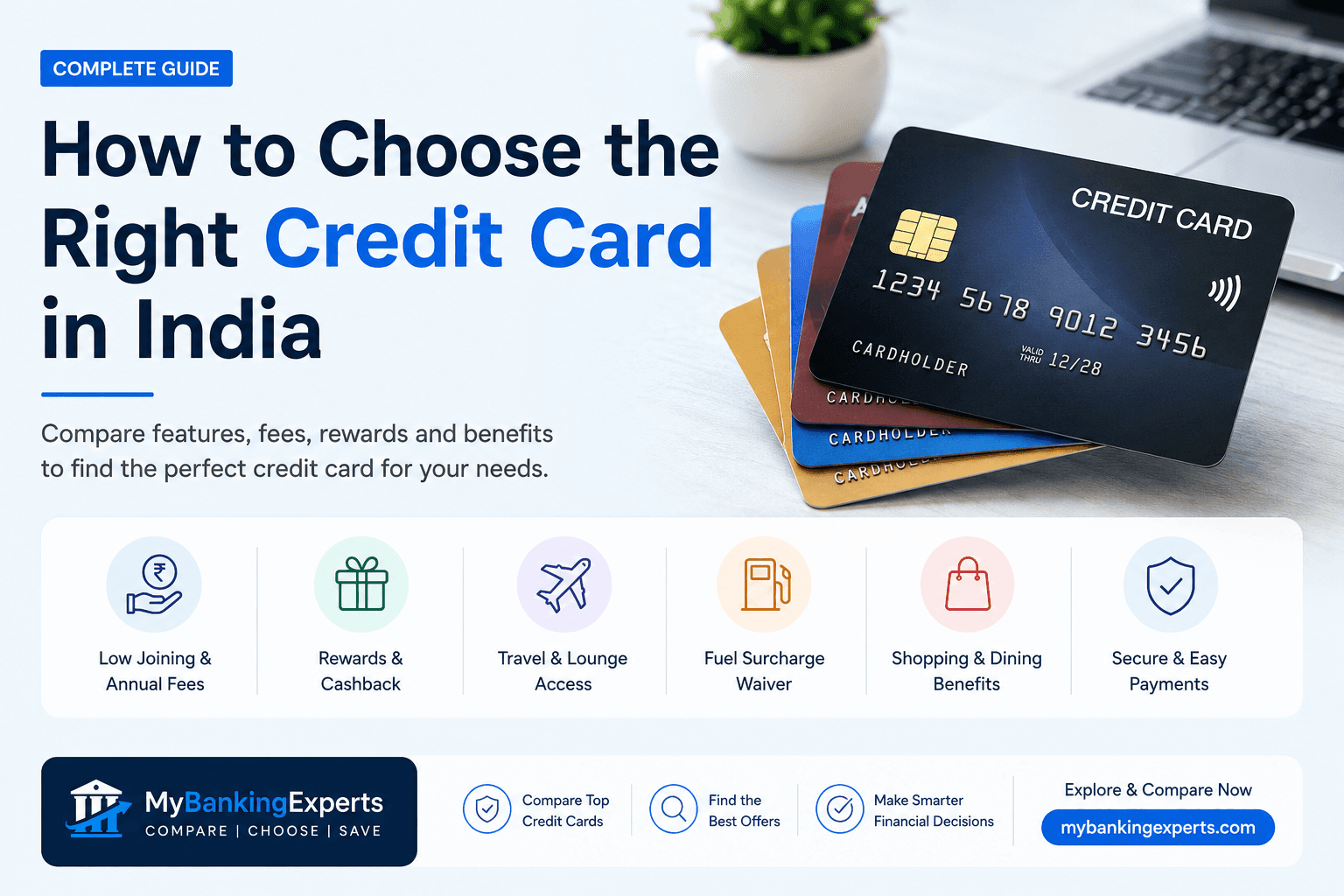
Choosing a credit card can be confusing. Banks offer cards with cashback, rewards, travel benefits, fuel savings, shopping offers, lounge access and many other features. But the best credit card is not necessarily the one with the most benefits—it is the one that matches your spending habits and financial needs.
At MyBankingExperts, you can compare financial products based on important factors such as fees, rewards, benefits and eligibility.
A credit card allows you to make purchases using a pre-approved line of credit provided by the card issuer. Instead of paying immediately from your bank account, you can repay the amount later according to your billing cycle.
If you pay the total outstanding amount by the due date, you can generally avoid interest on eligible purchases. However, carrying unpaid balances can result in significant interest charges.
Before applying for a credit card, look at where you spend most of your money.
For example:
Online shopping: Look for shopping rewards and cashback.
Dining: Consider cards offering restaurant or dining rewards.
Travel: Travel rewards, airline benefits and lounge access may be useful.
Fuel: Fuel surcharge benefits can help regular commuters.
UPI payments: Some RuPay credit cards may provide rewards on eligible UPI transactions.
Everyday expenses: A simple cashback card may be better if your spending is spread across multiple categories.
The goal is to choose a card that rewards the spending you already do rather than encouraging unnecessary spending.
Credit cards can have joining fees, annual or renewal fees, or both.
A card with a higher annual fee isn't automatically a bad choice. If its rewards and benefits are worth more than the cost for your spending pattern, it can still provide good value.
On the other hand, a free credit card can be attractive if you want basic benefits without worrying about renewal charges.
Always check:
Joining fee
Annual/renewal fee
GST and applicable taxes
Fee-waiver conditions
Additional card charges
Don't select a card simply because it advertises a high reward rate.
Check how the rewards work:
What purchases qualify?
Are there monthly or quarterly limits?
What is the value of each reward point?
Can points be converted to cashback?
Are there redemption charges?
Do rewards expire?
Are certain categories excluded?
For example, a card may offer attractive rewards but have a relatively low monthly maximum. Another card with a lower headline reward rate could potentially provide more value for your particular spending pattern.
Cashback cards can be easy to understand, but you should still read the terms carefully.
Some cards provide different cashback rates for different categories, while others may impose monthly cashback caps.
Before applying, check:
Cashback rate + eligible categories + monthly limit + exclusions
This gives you a much better idea of how much you can actually save.
If you travel frequently, travel-focused benefits may be more valuable than regular cashback.
Depending on the card, benefits may include:
Domestic airport lounge access
Railway lounge access
Travel reward points
Hotel-related benefits
Airline offers
Travel booking discounts
However, lounge access may come with spending requirements or usage limits. Always check the latest terms before applying.
One of the most important factors is the interest charged when you don't pay your total outstanding balance.
Credit card interest can be expensive, so you should avoid choosing a card solely because of rewards if you regularly carry a balance.
Ideally, use a credit card only when you are confident you can manage the repayment responsibly.
Credit card eligibility can vary depending on the issuer and card.
Factors may include:
Age
Income
Employment status
Credit history
Credit score
Existing relationship with the bank
Location
Existing debt obligations
Checking eligibility before applying can help reduce unnecessary applications.
Having multiple credit cards isn't automatically a problem, but applying for several cards within a short period may not be the best strategy.
Instead, shortlist cards based on your requirements and apply for the ones that genuinely fit your financial profile.
A simple approach is:
Identify your spending → Compare cards → Check eligibility → Review fees → Apply
Instead of visiting multiple bank websites and manually comparing dozens of terms, use a comparison platform to narrow down your options.
MyBankingExperts provides comparisons for credit cards and personal loans, with information such as fees, networks, rewards, benefits and eligibility-related details.
Compare Credit Cards on MyBankingExperts
There is no single credit card that is best for everyone.
Your Main RequirementWhat to Look ForCashbackHigh cashback on your regular categoriesShoppingShopping rewards and merchant offersTravelTravel rewards and lounge accessFuelFuel benefits and surcharge savingsUPIEligible RuPay/UPI rewardsLow costLow or zero annual feePremium benefitsTravel, lifestyle and exclusive benefits
The right choice depends on your spending habits, income, repayment discipline and the benefits you are actually likely to use.
A credit card should be selected based on value, not just marketing claims. Before applying, compare the annual fee, reward structure, cashback limits, benefits, interest charges and eligibility requirements.
Most importantly, don't spend more just to earn rewards. The biggest benefit of a credit card comes when you use it responsibly and repay your bills on time.
With the right comparison, you can find a credit card that fits your lifestyle and helps you get more value from your regular spending.